


Reserved Hall Seats: $60.00, $30.00, $27.50 (partial obstruction)
General Admission/Outdoors/Uncovered: $25.00, Students: $10.00
Featuring Adam Traum, Cindy Cashdollar, Byron Isaacs, Eugene Ruffolo, Kenny Kosek, and Tony Trischka
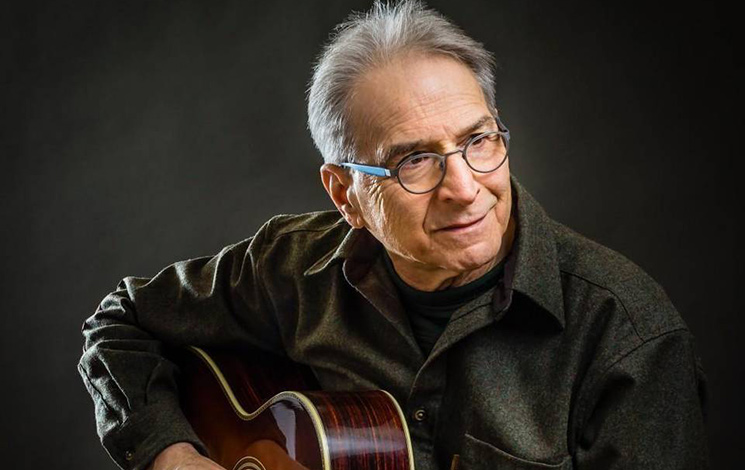
Happy Traum was smitten by American folk music and began playing guitar and 5-string banjo as a teenager. He was an active participant in the legendary Washington Square/Greenwich Village folk scene of the 1950s and ‘60s and studied guitar with the famed blues master Brownie McGhee. A first-rate fingerstyle guitarist and singer, he performed throughout the U.S., Canada, Europe, Australia, and Japan, as a soloist and member of various groups, including The Woodstock Mountain Revue. His avid interest in traditional and contemporary folk music earned him recognition as a performer, writer, editor, session musician, teacher, and recording artist.
Happy’s first appearance in a recording studio was at a historic session in 1963 when a group of young folk musicians, including Bob Dylan, Phil Ochs, Pete Seeger, Peter LaFarge, and The Freedom Singers gathered in Folkways Records’ studio for an album called Broadsides. Happy with his group, the New World Singers, then cut the first recorded version of “Blowin’ In The Wind,” and Happy sang a duet with Dylan on his anti-war song “Let Me Die in My Footsteps.” John Sebastian, Maria Muldaur, Cindy Cashdollar, Larry Campbell, and Allen Ginsberg are just a few of his many celebrated collaborators over the years since.
A true stalwart of the Woodstock music scene, Happy is known as one-half of Happy and Artie Traum, a duo he began with his late brother. Together, they put out several albums, including Happy and Artie Traum (1969), Double Back (1971), and Hard Times In The Country (1975). Amongst Happy’s many solo releases are Bright Morning Stars (2000), I Walk The Road Again (2005), Just For The Love of It (2015), and his most recent critically acclaimed CD, There’s a Bright Side Somewhere (2022).
He founded Homespun Music Instruction with his wife and partner, Jane Traum, in 1967. This treasure trove of instructional lessons continues to be available at Homespun.com.
Happy Traum’s musical impact will be felt for generations to come.
As a storyteller, Adam Traum wraps his catchy hooks with infectious grooves. His songs have a consistent verve, which reflects his belief in music as an essential element of the human experience. The material Adam writes evokes images of an Americana landscape spinning tales of love, heartbreak, beauty, and the occasional observational diatribe. When he performs live, Adam brings his sunny disposition and genuine love of playing music to the stage. His tasteful instrumental chops and relaxed but powerful voice are a great compliment to his well-crafted songs.
The rootstock of Traum’s music germinated in the fertile ground of the Catskill Mountains. He was raised in a musical family in Woodstock, New York, with a front-row seat to music history. His passion for music was enhanced by going to many festivals and shows in his formative years. As an aspiring guitarist, Traum was always welcome to pick along at jam sessions with family friends, many of whom happened to be musical luminaries.
Traum regularly raided his father’s record collection, listening to the masters of electric blues, country, and folk in addition to regular doses of rock albums he got at the local record store. He would spend hours playing along and figuring out his favorite riffs. Thanks to the time spent exploring these musical avenues, he became a well-rounded musician able to shift between genres nimbly.
After tenures in several rock bands as a young musician, Traum found the truth, beauty, and honesty in the roots of music he was raised around. One year at MerleFest in North Carolina, he had a musical epiphany after seeing Tony Rice play guitar. No gimmicks, no effects, just wood and steel! It was music made by people, for people. The authenticity of that performance is the benchmark he continually strives for, whether playing acoustic or electric music.
Cindy Cashdollar is an American musician specializing in steel guitar and dobro. She grew up in Woodstock, New York, where she perfected her skills by playing with bluegrass musician John Herald, blues musicians Paul Butterfield, and Levon Helm and Rick Danko of The Band. After residing in Austin, Texas, for 23 years, she has returned to Woodstock, New York. Cashdollar received five Grammy awards while playing for eight years with Asleep at the Wheel and has also collaborated with such noted performers as Bob Dylan, Van Morrison, Dave Alvin, John Sebastian, Rod Stewart, Leon Redbone, Redd Volkaert, Carla Olson, Albert Lee, Marcia Ball, Rory Block, Peter Rowan, Sonny Landreth, Amy Helm, BeauSoleil, Jorma Kaukonen, and Ryan Adams among many others. In August 2019, Cashdollar recorded dobro and lap steel on Save Your Love For Me, the new Grayson Hugh record. In 2003, the Academy of Western Artists recognized Cashdollar as Instrumentalist of the Year Award in the Western Swing Music genre. She was inducted into The Austin Chronicle Hall of Fame in 2011–12.
New York City singer/songwriter and guitarist Eugene Ruffolo is hard at work on his eighth studio recording, Ten Good Sermons, in which he explores themes such as forgiveness, the precious bonds of friendship, and the search for existential truth. His previous seven CDs have been acclaimed worldwide. A regular touring artist across the United States and Europe, his original songs have earned him first prizes in the Telluride Bluegrass and Merlefest songwriting competitions, and a Clio award for the first commercial soundtrack he ever composed. As a performer in both the studio and live onstage, his colleagues have included Garth Brooks, Tony Bennett, Kenny Loggins, and Mary Chapin Carpenter, and he has recorded over 115 songs for The Songs of Love Foundation, creating personalized songs for terminally ill children.
Byron Isaacs records and tours with The Lumineers. He met the band through producer Simone Felice and first contributed bass and backing vocals to their platinum-selling Cleopatra. He’s on their 2019 album III, which explores themes of addiction, and on their newest #1 album Brightside.
Isaacs also plays with guitarist Peter Cole in their New York City-based rock band Lost Leaders. Their fourth and latest EP was Jealous Sun, out in 2022, following Promises Promises in 2019. New music is forthcoming in 2024; in the meantime, the band performs with drummer Lee Falco (The Lemonheads) and keyboardist Will Bryant (Rachael Yamagata, Joan Osborne).
Isaacs was one of the six founders of the legendary Americana band Ollabelle, which toured with Diana Krall and was featured on T Bone Burnett’s Great High Mountain Tour. Ollabelle recently reunited to celebrate the 20th anniversary of their debut album.
Through his Ollabelle colleague Amy Helm, Isaacs met her father, Levon Helm, and joined his famous Midnight Rambles. He played on both of Helm’s Grammy-winning albums and wrote the song “Calvary” that Levon sings on Dirt Farmer. Isaacs also played and toured with Amy and produced her first solo album, Didn’t It Rain. Isaacs frequently appears at The Helm Family Midnight Ramble with Amy and her son Lavon Collins.
In June 2018, Isaacs released a solo album, Disappearing Man, to rave reviews. More recently, Isaacs has enjoyed songwriting collaborations with Jim Keller. He played on Noah Kahan‘s Busyhead and is on Carry Me Home, the 2022-released collaboration between Mavis Staples and Levon Helm.
During his decades-long career, Isaacs has also recorded and/or performed with Willie Nelson, Joan Baez, Bruce Springsteen, Patti Scialfa, Roseanne Cash, Jackson Browne, Nina Nastasia, Ryan Adams, Chris Smither, Richard Shindell, Mary Fahl, The Weight Band, Larry Campbell & Teresa Williams, David Baron and many others.
Tony Trischka, born in Syracuse, NY, is a renowned five-string banjo player known as the “father of modern bluegrass.” His musical journey began with the Kingston Trio’s “M.T.A.” and was influenced by a diverse range of music from Broadway scores to classical and folk music. Trischka moved to New York City in the early ‘70s, where he became part of a vibrant music scene, collaborating with artists like Andy Statman and Kenny Kosek.
His debut solo album, Bluegrass Light (1974), showcased his innovative blend of bluegrass with other genres like jazz and psychedelic pop. Over the years, he released several influential albums, including A Robot Plane Flies Over Arkansas (1983) and World Turning (1993), which featured collaborations with notable musicians such as Alison Krauss and members of R.E.M.
Trischka has also contributed to Broadway and off-Broadway productions and served as the musical director for the documentary Give Me the Banjo, narrated by Steve Martin. His work continues to inspire a new generation of progressive bluegrass musicians.
In addition to his recording and performing career, Trischka is a dedicated educator. He has taught at various music camps and workshops, sharing his expertise with aspiring banjo players. His instructional books and videos have become essential resources for banjo enthusiasts. Trischka’s influence extends beyond bluegrass, as he has explored genres like jazz, classical, and even avant-garde music, pushing the boundaries of what the banjo can achieve.
Kenny Kosek is one of America’s finest fiddlers. He has played and recorded with numerous bluegrass and new acoustic bands, including Country Cooking, Breakfast Special, Bill Keith, and Tony Trischka. In addition, he has worked with artists as diverse as Laurie Anderson, Steve Goodman, John Denver, James Taylor, Jerry Garcia, Loudon Wainwright III, and The New Blue Velvet Band. Kenny has played in several Broadway musicals, including Big River, Foxfire, and The Robber Bridegroom, and is the author of the book Bluegrass Fiddle Styles (Oak Publications).


